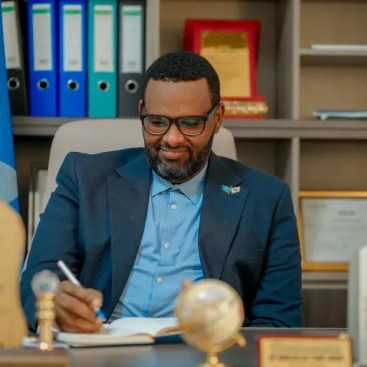
Author name: Dr Abdulrazaq Yusuf Ahmed

Dr. Abdulrazaq Yusuf Ahmed MBChB, MD, MPH, MSc(HM), PhD (Healthcare Economics), PhD (Demography & Social Sciences), FRSPH, FRSTMH, FeSMA Senior Executive Director │ Global Health Leader │ Kidney Donor Dr. Abdulrazaq Yusuf Ahmed, widely known as Dr. Jalaaludiin, is a Somali physician, public health specialist, health systems reformer, and national health-financing leader. With more than 15 years of progressively senior experience in clinical service, public-sector transformation, hospital leadership, emergency response, and health policy, he has built a distinguished career at the intersection of medicine, governance, and systems change. He currently serves as Director General of the National Health Insurance Authority (NHIA), Somalia, where he is helping shape the country’s health insurance agenda and advance financial protection, strategic purchasing, provider accountability, and Universal Health Coverage.   Over the years, Dr. Abdulrazaq has had the privilege of serving at the Federal Ministry of Health & Human Services at the national level, contributing to and leading the development, reform, and implementation of important health policies, strategies, guidelines, regulatory frameworks, and institutional systems. His leadership journey has included roles in national health systems strengthening, emergency coordination, health workforce governance, and hospital transformation. He previously served as Director of Human Resources Management and HRH Development, National Incident Manager for Somalia’s COVID-19 response, Senior Advisor and Team Lead for Health Systems Strengthening, and Director of Medical Services and Deputy Director General. He also led Demartino National Public Hospital, where he oversaw major service expansion, clinical governance reform, and continuity of care during the COVID-19 emergency.   A committed advocate for Universal Health Coverage, Dr. Abdulrazaq’s work is driven by a deep belief that strong institutions, equitable financing, accountable governance, and people-centered service delivery are essential to national progress. He has been actively engaged in institution-building in fragile settings, translating evidence into practical reforms, and championing more resilient and responsive health systems for Somalia. He is also a strong voice for mental health, health equity, and dignified access to care, recognizing that sustainable development must include the often-overlooked social and psychological dimensions of wellbeing.    In academia, Dr. Abdulrazaq is a senior lecturer, postgraduate coordinator, mentor, and public intellectual with teaching and training contributions in medicine, infectious diseases, health policy and planning, health systems, healthcare leadership, epidemiology, research methodology, and health economics across local and regional universities and institutes. He has supported postgraduate teaching and curriculum development, mentored emerging scholars and health professionals, and contributed to competency-based professional development in complex settings.  He is also a prolific researcher and writer, with more than 35 publications spanning health systems, health financing, governance, Universal Health Coverage, pandemic preparedness, One Health, infectious diseases, and mental health, alongside a growing body of public-facing articles, reflections, and policy-oriented thought leadership on health systems, public-sector reform, governance, community development, and social science. His work has appeared across peer-reviewed and scholarly platforms, and he continues to contribute to national and global conversations through research, commentary, and professional engagement.    Beyond government and academia, Dr. Abdulrazaq is active in international forums, leadership platforms, professional networks, and educational societies. He holds multiple fellowships and memberships, including the Royal Society for Public Health (FRSPH), the Royal Society of Tropical Medicine and Hygiene (FRSTMH), and other international professional bodies, and he has served in board-level and ambassadorial capacities. His leadership has been recognized through national and international awards, and he remains committed to using evidence, service, and institutional leadership to improve lives.   At the heart of his work is a simple but powerful mission: to help build a healthier, fairer, and more resilient Somalia. Whether through policy reform, institutional development, academic mentorship, research, or public advocacy, Dr. Abdulrazaq Yusuf Ahmed continues to advance a vision of health systems that are inclusive, accountable, and worthy of the people they serve.

Unknown's avatar
Resilience

Reviving Demartino Public Hospital

Reviving De Martino Public Hospital: A Roadmap to Sustainable, High-Quality Care in Times of Crisis. “Sustaining Essential Healthcare in the Face of Compounding Crises”  After five years of steadfast leadership at De Martino Public Hospital a national institution entrusted to me during a time of significant uncertainty I find myself reflecting not only on the journey of this hospital, but on the resilience of a vision tested by adversity and refined through necessity. When I assumed leadership, De Martino operated with just 20 beds, constrained by limited infrastructure, skeletal staff, and financial fragility. Today, through deliberate expansion and collective sacrifice, we have grown into a 300-bed facility, nationally recognized as the primary referral and emergency response hospital in Somalia. This transformation, however, did not occur in ideal conditions it emerged through a crucible of persistent hardship, interrupted funding, a workforce often without contracts or formal protections, and the painful proximity of project failure. Today, De Martino stands as a cornerstone of the Somali healthcare system. It has transcended its role as a mere hospital to become a national sanctuary. It is the nation’s primary tertiary referral center for the most complex medical cases, a refuge for the vulnerable, and the sole public-sector pandemic response center, which managed over 32,000 COVID-19 cases during the recent global health crisis. It is here that we provide critical care for the national army, treat the devastating injuries of war and conflict, and fulfill our national obligation to respond to the gravest health emergencies.  This unfunded mandate has placed an extraordinary strain on our resources, creating a persistent disconnect between our critical responsibilities and the financial support allocated to us. This volume chronicles the rich history of De Martino Public Hospital Somalia’s oldest and largest public medical center and the unforgettable partnership with the Ministry of Health that has enabled its transformation into a true national referral hub.  Here you will read how our hospital has stood as a sanctuary for the gravely ill, a frontline responder to every infectious outbreak, and a lifesaving resource for our national army and civilians wounded by conflict. Beyond clinical care, we have hosted ministry programs, trained future generations of nurses and clinical officers, and upheld our solemn obligation to deliver equitable, high-quality services to every Somali citizen. Within these pages, you will find not only an honest appraisal of the crises we have faced—but also practical recommendations drawn from hard-won experience. My hope is that this book serves as both a blueprint for sustainable hospital management in fragile settings and a lasting legacy for those who follow. May our story inspire others to confront challenges with courage, to innovate under pressure, and to recommit to the enduring mission of safeguarding health, even in the most trying times. Read the full article on the pdf attached 

Resilience

Institutionalization of Health Emergencies

Preparedness and Response Somalia’s vulnerability to health emergencies necessitates a robust institutional framework for preparedness and response. This paper outlines the progress and strategies implemented by the Somali health sector to institutionalize health emergencies preparedness and response. Critical to this endeavor is the development of the Health Sector Emergency Preparedness and Response Plan, which is anchored on system resilience, surveillance enhancement, international partnerships, and community engagement. Read more at the attached

Resilience

From the Frontlines to the Foundations: A Deeper Look at Resilient Leadership

Building resilient public health systems begins not in policy briefs, but on the ground where infrastructure fails and human need is most acute. My journey from the frontlines of humanitarian aid to national policy leadership was defined by a single question: how do we translate immediate, crisis-driven solutions into enduring, systemic change? This is not a matter of moving from one career to another, but of integrating two halves of the same calling: to be both a healer who addresses immediate suffering and a builder who erects the foundations of lasting wellness. The Foundational Lessons of Fieldwork The engine of a worn lorry stopped, releasing a cloud of ochre dust into the air. Upon stepping down, the intensity of the sun and the dry, cracked soil indicated the challenging environment. In this remote area, routine examinations carried significant weight, often determining critical outcomes for individuals. Service here was direct and practical, with actions having immediate and notable consequences. A mother, visibly tired and concerned, brought her child for medical attention. Her response to the treatment administered highlighted the importance of timely care. These encounters had a notable impact on my professional development and approach to leadership. My team of volunteers efficiently unloaded medical supplies and established a temporary clinic. Each situation required prompt action a child needing care, a parent seeking assurance. Our work provided humanitarian assistance, reinforcing the purpose behind this line of service. Medical care provision also contributed to rebuilding trust within a community previously affected by conflict and neglect. Despite the value of grassroots efforts, I recognised their limitations and considered broader strategies beyond the local setting. These experiences informed my ongoing perspective, connecting fieldwork with future initiatives.   Frontline conditions provided practical lessons in empathy, resilience, and effective care delivery. They demonstrated the necessity of listening to community needs over applying generalised solutions, underscored the importance of presence and communication, and emphasized that effective responses arise from addressing, rather than avoiding, challenging circumstances.   This practical knowledge of vulnerability and the effects of intervention guided my subsequent work and ensured that professional objectives remained relevant to the communities served. From Crisis Response to Systemic Change Although frontline work is urgent and compelling, it became clear that translating these immediate lessons into enduring solutions was essential. This realization eventually brought me from crisis response environments to the administrative setting of the ministry,  My role evolved into one of connecting on-the-ground needs with systemic policy initiatives, prompting a key question: how can immediate compassion be effectively integrated into lasting institutional frameworks?   My path to leadership positions was not defined by accolades, but rather by practical experience and a commitment to service. Early experiences as a clinician, activist, and student leader provided critical opportunities for development.  Through these roles, I recognized that genuine stewardship involves consistently applying one’s abilities to address pressing challenges. These varied experiences formed the basis of my leadership approach, underscoring that authority is established through demonstrated expertise and direct engagement with complex issues. Policies are most effective when grounded in practical understanding rather than abstract concepts.  This perspective values humility, inclusivity, and a steadfast commitment to serving the broader community. Each challenge whether navigating organizational dynamics or managing humanitarian projects offered valuable insights into resource mobilization, consensus building, and principled leadership. Collectively, these experiences have equipped me with a comprehensive foundation for responsible and impactful institutional leadership. The Unseen Training Ground: Stewardship of Gifts My professional journey commenced not through prestigious titles or official appointments, but through the formative experiences encountered as a young medical graduate. Opting for an unconventional path, I engaged in humanitarian work, activism, and student leadership prior to holding any public office. These roles served as critical foundations for my development. Through student activism, I acquired valuable skills in collective action by organizing health initiatives that delivered essential care to underserved communities, fostering abilities in resource mobilization and coordinated teamwork. As a humanitarian worker, I observed firsthand the significance of empathy and proactive engagement, recognizing that understanding a community’s needs is fundamental to effective support. These responsibilities required adaptability, innovative thinking, and efficiency under challenging circumstances.   Such experiences were integral, rather than peripheral, to shaping my approach to leadership. They reinforced the principle that stewardship entails utilizing one’s abilities in service to others, deploying expertise, knowledge, and enthusiasm to effect positive change that extends beyond immediate contexts. The Transformative Power of Frontline Encounters There are moments in life when the boundaries between the abstract and the immediate dissolve, and one is left face-to-face with the raw, unfiltered reality of human need. For me, this clarity emerged amidst the clamour and chaos of frontline medical work, where suffering was not a distant concept, but a living presence.  I can still recall, with vivid intensity, the trembling hands of a mother as she placed her feverish child before me, hope and desperation intermingled in her gaze. In that instant, every decision, every action, became weighted with consequence.  The relief that radiated from her, silent yet profound, upon receiving care, served as a wordless testament to the transformative power of compassion in its purest form. Such encounters are searing; they do not merely inform, they transform.  They cultivate a kind of empathy that cannot be taught in lecture halls, forging resilience in the crucible of crisis and instilling a deep reverence for every life touched. It is in these unvarnished classrooms that leaders are truly made, learning that each act of service is a seed sown for a greater future. Stewardship in Action: Leadership Forged Through Service My own odyssey towards leadership did not begin with titles, accolades, or the trappings of authority. Instead, it was shaped by the unyielding determination of a young doctor, hungry to serve rather than to be served. Every chapter whether spent listening in crowded clinics, rallying voices as a student leader, or raising banners as an activist became a forge in which both skills and spirit were tempered. Through this journey, I discovered that stewardship

Uncategorized

A Journey of Healing, Knowledge, and Leadership

Physician | Global Health Leader | Health Systems Specialist | Academic Writer “Resilience is not born from comfort, but from conviction ;the belief that healing one life can lead to the healing of a nation.” Welcome to DrJalaaludiin.com, the official platform of Dr. Abdulrazaq Yusuf Ahmed Dr. Jalaaludiin a Somali physician, visionary health systems reformer, and global advocate for equity in healthcare. Here, medicine meets meaning. From the frontlines of emergency wards to the strategy tables of national health reform, Dr. Jalaaludiin’s journey reflects a lifelong mission to make care accessible, compassionate, and sustainable, especially in fragile settings, Greetings from Mogadishu a city whose story of resilience mirrors my own journey. I am Dr. Abdulrazaq Yusuf Ahmed, known to many as Dr. Jalaaludiin  physician, public health specialist, and advocate for systems that place human dignity at their heart. My path has carried me from the dust of emergency wards to the deliberative halls of policy, from treating patients one by one to building institutions that can serve them all. Over the past fifteen years, I have worked to transform Somalia’s health sector through leadership, science, and service. As Director of Human Resources Management at the Federal Ministry of Health and Human Services, and former Director General of De Martino Public Hospital, I have seen first-hand how courage and collective purpose can turn scarcity into strength. When I first walked through De Martino’s doors, it was a modest twenty-bed unit; today it stands as a 375-bed tertiary and specialty center — twice named Somalia’s Best Public Hospital — and a living testament to what disciplined compassion can achieve  . My calling stretches beyond hospital walls. I serve as Coordinator of the Master’s Program in Tropical Medicine and Infectious Diseases at Benadir University, mentor emerging health leaders, and write extensively on leadership, resilience, and systems transformation. My essays — “A Deeper Look at Resilient Leadership,” “Stewardship Under Fire,” and “Beyond Survival: A Somali Vision for Mental Health” — trace the arc from crisis response to systemic change, urging that every challenge be repurposed into progress   . As a global health leader, kidney donor, and researcher, I believe medicine is both science and stewardship. Healing communities demands data, but also empathy; policy, but also poetry. My scholarly work — spanning healthcare economics, mental health, One Health systems, and post-conflict recovery — has been guided by a single conviction: that resilient health systems are not built by infrastructure alone, but by integrity, transparency, and trust. Through this site, I aim to share not only research and professional updates, but reflections on leadership, wellbeing, and the moral architecture of public service. It is a space for dialogue — between clinician and citizen, scholar and storyteller, Somalia and the wider world. Welcome to a journey from frontlines to foundations, where medicine meets meaning. Welcome to DrJalaaludiin.com — a platform dedicated to health, humanity, and hope. (Dr. Abdulrazaq Yusuf Ahmed – Dr. Jalaaludiin, MD | MPH | MSc | PhD | FRSPH | FRSTMH | FeSMA)

Scroll to Top